

Merz says ‘shock’ AfD victory in key German state ‘is an election result we cannot simply move past’ – Europe live
German chancellor says vote for far-right party ‘will have repercussions’ across the country

silverguide.site –
Closing summary
And, on that note, we will be closing the blog for today.
-
German chancellor Friedrich Merz said last night’s triumph of the far-right Alternative für Deutschland in the Saxony-Anhalt election means the government “cannot simply move past as if nothing happened,” as he accepted “the most severe election defeat” in “years, indeed in decades” (13:39).
-
Merz said the country still needed “fundamental reforms” (13:43) and defended his government’s track record (14:03), as he rejected any talks of “giving up” and resigning from the post (14:00).
-
His CDU party’s state leader in Saxony-Anhalt conceded the party had no longer a mandate to govern in the state (13:49).
-
Meanwhile, triumphant AfD leaders celebrated “a dream result” (10:37), which they said showed the growing appetite for change in German politics (10:40).
-
Merz criticised the AfD’s close links with Russia (14:00), and pledged to continue Germany’s support for Ukraine, despite growing popularity of pro-Russian parties (14:18) and the latest wave of hostile moves from Russia (15:52).
In other news,
-
Bosnian Serb war criminal Ratko Mladić was buried in Belgrade after a controversial funeral with army honours (12:26, 13:11), which prompted furious criticism from the EU and Bosnian survivors accusing Serbia of “glorifying” the general (12:50, 12:58, 13:05).
-
Hours after the funeral, Serbia’s government asked president Aleksandar Vucić to dissolve the parliament and call a snap election, seen as Vucić’s attempt to tighten his grip on Serbian politics after two years of student-led protests (16:32).
Separately,
-
European Commission president Ursula von der Leyen presented a €200m investment package for Greenland during her visit to the territory, as the EU seeks to strengthen its ties with Greenland and show solidarity amid continued US interest (14:23, 14:50).
If you have any tips, comments or suggestions, email me at jakub.krupa@theguardian.com.
I am also on Bluesky at @jakubkrupa.bsky.social and on X at @jakubkrupa.
EU's report to challenge conventional thinking on defence scrapped amid opposition from big member states
in Brussels
Meanwhile, an initiative from the EU’s top diplomat “to challenge the conventional thinking” on Europe’s defence has been scrapped, after opposition from big EU member states.
Kaja Kallas, the EU high representative for foreign affairs and security policy, had hoped to announce on Monday a high-level group of grandees - retired ministers and defence experts – to draft a report to bolster Europe’s defence policymaking.
But the plan has been definitively abandoned, following opposition led by Italy, France and Germany, who claimed to have not been consulted, EU sources told the Guardian.
Kallas announced the group ahead of a meeting of EU defence ministers last Tuesday where she said she wanted the group “to challenge the conventional thinking and look beyond doing more of the same”.
The group was meant to produce a ‘Draghi report for defence’, a reference to the widely lauded set of recommendations from the former Italian prime minister Mario Draghi, which is the unofficial bible of EU economic policy. Representatives from the UK and Ukraine were to be included.
But less than 24 hours before a big launch event in Brussels on Monday morning, the EU’s diplomatic service announced its cancellation.
One EU official said:
“Some member states felt this was not the right path to pursue at this moment. After some discussion with ministers, we have decided not to proceed with the initiative.”
The person added:
“The diagnosis has not changed: Europe needs to deliver faster on defence. We don’t want to find ourselves in a situation in a few years’ time, where we look back and find that Europe was so focused on where it needed to be in 2035 that it failed to do what was necessary in 2027.”
The last-minute cancellation caps a difficult period for Kallas, who has also faced a Franco-German proposal to dismantle the diplomatic service she leads and sweep some of its functions into the European Commission.
But the former Estonian prime minister is not giving up. Kallas is expected to raise the issue of Europe’s defence preparedness when EU ministers meet at the end of the month (28 September).
Why is far-right AfD’s state victory significant and what might happen next in German politics?
Berlin correspondent
Back to Germany, the country is reeling from the biggest far-right victory in a state election since the Nazi period after voters in Saxony-Anhalt in the former communist east gave the anti-immigration, pro-Kremlin Alternative für Deutschland (AfD) party a thumping first-place finish of 44%, just short of an absolute majority.
Our Berlin correspondent Deborah Cole looks at some of the key questions in the aftermath of the vote.
“Coming in nearly 27 points ahead of the co-ruling Christian Democrats (CDU), the conservative party of the chancellor, Friedrich Merz, the AfD pulled off a coup whose aftershocks will ripple across Germany and beyond its borders.
The AfD will have broad powers over education, culture and domestic security if it manages to take power in the state. Among other policies, it has promised to start a remigration and deportation offensive, ban rainbow flags in schools, and halt the building of new windfarms. It now has a strong wind at its back for the two state elections yet to come this month. …
Its triumph also raised doubts whether the unpopular Merz could hold on in the face of such a clear rejection of his policies and leadership after just 16 months in power.”
Serbia's government asks president to dissolve parliament, call early elections
Meanwhile, we are getting more news from Serbia, where – just hours after Ratko Mladić’s controversial funeral – the country’s government asked president Aleksandar Vucić to dissolve the parliament and call a snap election.
The next parliamentary elections in Serbia are not due until December 2027, but there had been growing speculation in recent weeks that the government could push for an earlier vote in mid- to late-October.
Reuters noted that the move could allow Vucić, whose Serbian Progressive Party nominated him on Saturday to run for prime minister, to try to tighten his grip on Serbian politics after nearly two years of student-led protests that have presented the biggest challenge to his rule.
Vucić, who has run the country as president or prime minister for 12 years, has faced anti-corruption demonstrations triggered by the collapse of a concrete canopy at a railway station in the northern city of Novi Sad in November 2024 that killed 16 people, Reuters said.
The opposition and demonstrators accuse Vucić and his allies of violence against political opponents, rampant corruption, ties with organised crime and stifling media freedoms, all of which Vucić and his allies deny.
A recent poll by Faktor Plus for Blic has Vucić’s SNS on 47.2% of the vote, with the student list at 31.5% in the second place, and the Socialist Party of Serbia in third with 4.9%.
The vote is expected to be held on 25 October, local media reported.
Updated
Russia orders Germany to close St Petersburg consulate, Goethe Institutes in retaliation for Leipzig drone attack attribution
Meanwhile, as sort of expected (Europe Live, 1 September), Russia has just ordered the German consulate in St Petersburg to close down as part of its retaliation against Germany’s decision to formally blame Russia for the recent attempted drone attack at Leipzig airport.
In line with the Russian foreign ministry’s decision, the consulate needs to close down by 18 September – the same deadline that the German authorities have given to the Russian consulate in Bonn.
Germany’s cultural Goethe Institutes in Russia must close down and their staff leave by 13 September, it added.
“It was stated that it was the German authorities who once again provoked a new round of escalation in bilateral relations. All responsibility for the consequences lies entirely with the German government,” the Russian ministry said.
Updated
Key event
Back to German politics and the Saxony-Anhalt result, barring any defections (14:09), the only German party that has signalled readiness to work with the AfD is the populist left-wing BSW, Reuters noted.
The BSW, which narrowly cleared Germany’s 5% electoral threshold, shares the AfD’s hostility towards mass immigration, which it says undermines local workers’ rights, and also advocates for ending Germany’s support for Ukraine and restoring ties with Moscow.
Both parties characterise sanctions on Russia as needlessly self-sabotaging, denying German businesses access to Russia’s vast cheap energy resources on which Germany’s export-driven economy was able to thrive for decades.
One to watch.
German auto firm Volkswagen has said that one of its plants would be sold off and converted to make defence equipment after car production ends there, AFP reports.
VW’s Osnabrück plant, in northwest Germany, is to be sold to Tel Aviv-based investors Aurelius Capital and the German state of Lower Saxony, a major VW shareholder, with an initial air defence project planned for the Israeli firm Rafael Advanced Defence Systems.
Updated
A little more of European Commission president Ursula von der Leyen’s words in Greenland earlier here:
Greenland can count on the EU. Territorial integrity sovereignty, the inviolability of borders, these are fundamental principles of international law. We want to be very clear and repeat again here that Greenland’s future is for the people of Greenland and Denmark to decide, no one else.
EU's von der Leyen unveils €200m 'partnership package' for Greenland amid US interest
Meanwhile, EU’s Ursula von der Leyen, Greenland’s PM Jens-Frederik Nielsen and Denmark’s PM Mette Frederiksen are speaking in Nuuk, Greenland.
Their press conference is part of von der Leyen’s landmark visit to Greenland, during which she pledged €200m to invest in projects there focusing on energy, raw materials and connectivity there, AFP reported.
The new EU-Greenland Partnership Package is meant to strengthen the territory’s ties with the EU amid continuing interest from the US president, Donald Trump.
In a pointed remark, von der Leyen said the bloc “stands in full solidarity with Denmark and Greenland,” and Greenland’s future is only for the people of Greenland to decide.
You can follow their comments here:
Updated
Merz ends the presser with another defence of his time in the government, and saying he needs to get better at explaining his rationale and reforms to the public.
He concedes there is a problem, and he needs to address it.
And that’s where the press conference ends.
Merz says he will not deviate 'even a millimeter' from pro-Ukraine course despite support for pro-Russian parties
Merz also gets asked about Germany’s position on Russia and Ukraine given the high support for pro-Russian parties in Saxony-Anhalt.
He says it was 57.7% of the vote last night.
He says resolutely that he will “not deviate by even a millimeter from my fundamental conviction that we must defend our freedom, especially now, from Russia.”
“I will likely have to explain this much more frequently and much more intensively,” he concedes.
But he says the threat to Germany’s internal security “is not abstract; it is very concrete” and that “if we stop supporting Ukraine, things will not get better, but worse.”
“The goal of the Russian leadership is to destabilise the value system of what we used to call the West. And that value system is not up for negotiation.”
Updated
Merz gets asked about the concerns reported among some minorities in Saxony-Anhalt about what could happen if AfD came to power.
The Guardian’s Ashifa Kassam covered that extensively before the vote.
He says that all state governments have to abide by the constitution.
“That holds true today, and will hold true tomorrow.”
'Giving up is not an option,' Merz says
In a more direct question, Merz gets asked at what point he would be prepared to accept his approach is failing and conclude that he can no longer serve as the chancellor.
Could the two other upcoming state elections be his breaking point?
He says he is “thinking hard how we can find our way back to shared political success.”
He says he is “not the sort of person that wears their emotions on their sleeve every day,” but “giving up is not an option.”
CDU's Saxony-Anhalt leader 'cannot see' defections to help AfD get majority
Merz also gets asked about apparent differences of opinion within the coalition government with the SPD.
He says “we need to talk” between partners, but lists what he focuses on what he says are some of this government’s success stories.
He says more needs to be done to remove obstacles to competitiveness and reduce bureaucracy.
Saxony-Anhalt’s Schulze gets asked if he can see some CDU politicians defecting to AfD to give the party a majority in the state parliament.
He says the AfD previously said it would not want to talk to other parties. But he says he cannot see any members of the CDU faction leaving to join AfD.
Merz also broadly defends his government’s track record.
He says the government will need to “demonstrate that the path we chose last year … is the right one” to regain public trust.
Merz also gets asked about his personal responsibility for allowing the AfD to gain in strength.
He points to both international trends, and domestic reasons.
He says “reassessing this situation” is needed to respond to this crisis.
But he says any democratic government relies on compromises, and “perhaps we need to emphasise, explain, that point more.”
He says he “has been reflecting” on these issues for some time, but does not elaborate as to what he is actually planning to do about it - for now.
AfD win celebrated '2,500 kilometers east from here,' Merz says
In further comments, Merz comes fairly close to drawing a link betweeen AfD and Russia, as he says “2,500 kilometres in the east, the election results were being celebrated.”
“That comes as no surprise, given who tried to foster and bring about this outcome. In that sense, we know exactly who we are dealing with here.”
CDU 'no longer has mandate to govern' in Saxony-Anhalt, outgoing premier concedes
Saxony-Anhalt’s outgoing premier Sven Schulze concedes the vote and says the party “no longer has a mandate to govern” and will be in the opposition.
“The mandate to govern now lies with the AfD,” he says.
He says the decisions on what’s next lie down with the elected members.
Merz says he wants to focus on this in the coming days and weeks, and says he is aware of “our shared responsibility for our country.”
“I am aware of my personal responsibility for our country. I am determined to live up to this responsibility,” he says, seemingly dismissing any talk he could choose to step down from the post.
Germany needs 'fundamental reforms,' Merz says
Merz says Germany needs “fundamental reforms” in response to the result, a challenge he says he is ready to face.
“It is a matter of nothing less than the future of our country and the opportunities available to our children and grandchildren – opportunities we must not squander,” he says.
He says the government needs to get better at explaining its actions and rationale behind them.
Merz says it is “the very essence of democracy” that people’s attitudes shift, but he says “there is one thing that is not up for a vote: the rules by which we live together and the values enshrined” in the constitution.
He says Germany “bears a special responsibility due to its history,” and will “always uphold our political order.”
Merz concedes 'most severe election defeat' in 'years, or decades'
Merz begins by saying “we are all deeply shocked” by the result in Saxony-Anchalt.
“We did not expect it to turn out this way,” he says.
He says the vote “will have repercussions” and says even a glance at who congratulated the AfD shows “the level of international attention this result has garnered.”
He says that “when nearly 60% of voters … cast their ballots for political parties that fundamentally call into question our country’s democratic institutions … it is an election result we cannot simply move past as if nothing happened.”
He concedes this is “the most severe election defeat the CDU has suffered in years, indeed in decades.”
Germany's Merz reacts to Saxony-Anhalt election result
Merz is speaking now.
I will bring you the key lines.
Updated
Far-right AfD win in Germany is ‘grave moment’ for Europe, politicians warn
Europe correspondent
Mainstream politicians around Europe have expressed alarm after the far-right Alternative für Deutschland (AfD) swept to a historic state election victory in Germany, while nationalist figures cheered the result as a mandate for change.
While falling just short of an absolute majority, the AfD surged into first place in the Saxony-Anhalt state election on Sunday, exit polls showed, putting the far right within reach of power at the state level for the first time since the second world war.
'We cannot simply carry on as before,' Merz reportedly told party bosses, as he prepares to respond to AfD win
Back to Germany, we are expecting to hear from chancellor Friedrich Merz in the next half hour.
As reported earlier (11:22), he chaired a crisis meeting with his CDU colleagues this morning, and Bild reported that he said the AfD’s win in Saxony-Anhalt had shaken his CDU party to its core and signalled that a major reckoning was needed.
“This shakes our party to its very foundations. We cannot simply carry on as before, nor can I, nor can the federal government,” Merz said, according to the newspaper.
Let’s see what he says in his first public comments since the election soon.
I will bring you his comments here live, obviously.
The funeral service has just concluded with the church bells marking the occasion, as can be heard on Tanjug news agency’s live stream, which shows thousands of Mladić’s supporters gathered in the area.
Mladić is expected to be buried at a cemetery nearby in the next hour or so.
Updated
UK Srebrenica charity criticises Mladić's funeral with honours, urges UK government to condemn it
A UK-based charity organisation Remembering Srebrenica issued the following statement in response to today’s funeral in Belgrade.
“Remembering Srebrenica condemns today’s full military honours funeral in Serbia for convicted genocide perpetrator Ratko Mladić.
There can be no honour in celebrating a man convicted of genocide, the gravest of international crimes, alongside crimes against humanity and war crimes.
Ratko Mladić was not a hero. He was a convicted war criminal who was found responsible for the worst genocide in Europe since the second world war.
The decision to honour him with a military ceremony and public glorification is an affront to humanity and the victims and the survivors of the Bosnian genocide. It sends a deeply disturbing message that genocide can be celebrated, hatred promoted and the perpetrators of evil glorified.
Those who participate in, endorse or glorify this spectacle should be ashamed. To celebrate Mladić is to celebrate a man whose forces murdered tens of thousands of Bosniak Muslims across Bosnia and Herzegovina, terrorised civilians during the siege of Sarajevo, perpetrated widespread persecution and forced displacement, and operated a network of concentration camps where people were imprisoned, tortured and abused. Between 20,000 and 50,000 women and girls were subjected to rape and sexual violence. Over two million people were driven from their homes and displaced.
It is sickening that, rather than remembering the victims, an evil man is being celebrated and remembered.
Reconciliation cannot be built on the glorification of those responsible for genocide. Peace cannot be secured by rewriting the past. The people of Serbia and Bosnia and Herzegovina, like people everywhere, deserve a future founded on truth, dignity and peaceful coexistence, not one built around the glorification of an evil person convicted of genocide, or the denial of the Bosnian genocide, or the continued promotion of hatred and division.”
The group’s chair, Waqar Azmi, said they asked the UK government to formally condemn the funeral with military honours.
OSCE expresses 'serious concern' about coverage of Mladić's funeral, blocked in Bosnia
Meanwhile, the Organization for Security and Co-operation in Europe (OSCE) expressed “serious concern” over the Serbian TV RTRS’s direct live broadcast of Mladić’s memorial services.
In a statement, it said:
“Reporting on events of legitimate public interest is an essential part of media freedom and editorial independence. While reporting on events of public interest falls within the media’s editorial remit, particular concern arises given that content glorifying a convicted war criminal was amplified without adequate editorial context or reference to judicially established facts. Public service broadcasters have a particular responsibility to provide accurate, impartial and properly contextualized journalism.
…
Respect for judicially established facts and for the dignity of victims and survivors is fundamental to responsible journalism, reconciliation and lasting peace in Bosnia and Herzegovina. Any media coverage of the forthcoming funeral should accordingly be accurate, properly contextualised and consistent with applicable professional and ethical standards.”
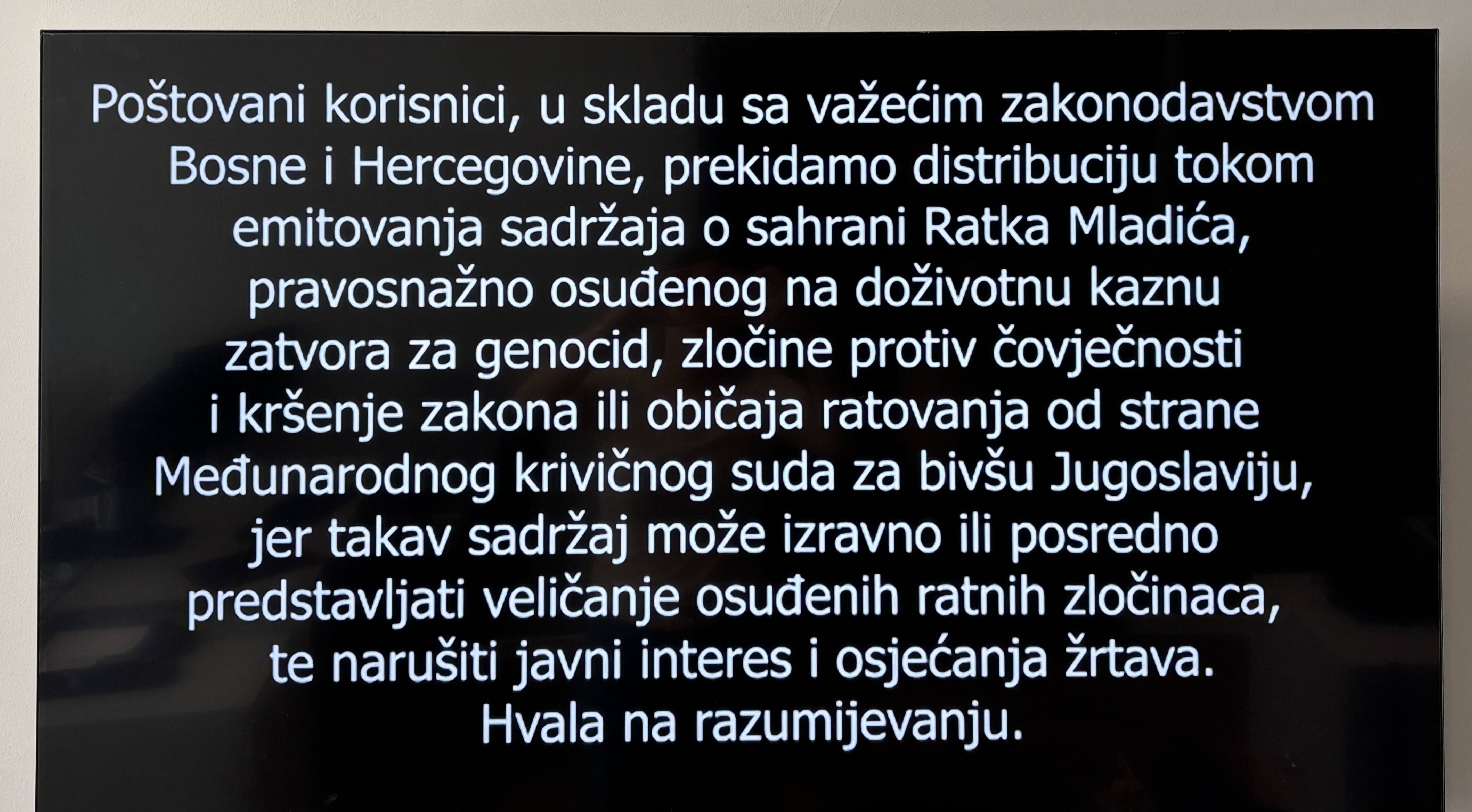
Serbian and Bosnian media reported that Bosnian TV network BH Telecom temporarily removed the Serbian news channel from their offer to block their signal during the funeral.
Instead, the viewers could see a statement saying the broadcast was blocked because “such content may directly or indirectly represent the glorification of convicted war criminals, and violate the public interest and the feelings of the victims,”
Glorification of war criminals, genocide denial contradict fundamental EU values, spokesperson says
A spokesperson for the EU’s foreign policy chief, Kaja Kallas, issued the EU’s response to today’s funeral in Belgrade, stressing that “any glorification of war criminals, genocide denial and revisionism contradict the most fundamental European values and have no place in the EU or in EU candidate countries.”
“The Western Balkan armed conflicts of the 1990s were among Europe’s darkest moments in its recent history. We are standing in solidarity with all victims, survivors and their families who suffered from war crimes in countries of former Yugoslavia.
Ratko Mladić was a convicted war criminal who had committed war crimes, genocide, and crimes against humanity. He died while serving a life sentence for crimes against humanity and the genocide in Srebrenica. The International Criminal Tribunal for the former Yugoslavia sentenced him to life imprisonment in 2017, describing his crimes as among the most heinous crimes known to humankind.
Any glorification of war criminals, genocide denial and revisionism contradict the most fundamental European values and have no place in the EU or in EU candidate countries. Reconciliation and good neighbourly relations in western Balkans remain central to building a shared future.
The EU is a partner to all countries in the Western Balkans to support their efforts to foster reconciliation and regional stability, as well as to find and to implement definitive and inclusive solutions to our partners’ regional and bilateral disputes and issues rooted in the legacy of the past, in line with international law.”
The EU was challenged further on its response during its daily midday briefing, with reporters repeatedly pushing for more detail on the EU’s response and pointing out that, despite the official line, Serbian government and army officials were still taking part in the funeral.
The commission did not meaningfully engaging with their questions, repeating only that “there is no place for glorification of war criminals or of those who denied genocide.”
Mladić's funeral gets under way in Belgrade
Meanwhile, the funeral of Bosnian Serb war criminal Ratko Mladić is now under way in Belgrad amid controversy over “glorification” of his actions during the war in the 1990s.
The ceremony started in the last half hour, after Mladić’s coffin lay in state allowing his supporters to pay last tributes.
Thousands of people are gathered in Belgrade to follow the proceedings, and the memorial service is led personally by the Patriarch of the Serbian Orthodox Church, the head of the church.
Serbia’s government figures initially suggested he would be given formal state honours – and Mladić’s casket was carried from the plane by soldiers and draped in flags – but president Aleksandar Vucić later decided against it. He also said he would not attend the ceremony as he is meeting with the president of Uzbekistan.
But the president rejected the accusations of glorifying the former general – including from senior EU figures, such as the bloc’s enlargement commissioner Marta Kos, who cancelled her planned trip to Serbia – saying the funeral service is merely in keeping with the family’s wishes, AFP said.
As Julian Borger, who covered the Balkan war in the 1990s and the horrors of Srebrenica first-hand, said in his obituary for Mladić:
“Mladić had ordered the executions of all males of army age or deemed old enough to bear arms. More than 8,000 men and teenage boys were mown down in what would be the worst massacre Europe had witnessed for half a century.
At the time of his death, in a UN prison hospital in The Hague, Mladić, one of the most reviled mass killers in modern European history, was serving a life sentence.
However, among nationalists in Serbia and the Serb half of Bosnia, the Republika Srpska, he is still portrayed as a hero – powerful evidence that the murderous ideology he embodied is still very much alive.”
Mladić will be buried at the Topčider cemetery where his daughter Ana, who killed herself during the Bosnian war, is also buried.
Updated
Saxony-Anhalt election results - in full
Italian press write about 'darkness above Berlin' after AfD's state election win
in Rome
All of Italy’s daily newspapers have led with AfD’s victory in Saxony-Anhalt, with La Repubblica’s headline describing it as “the darkness above Berlin”.
The political reaction exposes the divisions in Giorgia Meloni’s ruling coalition. Matteo Salvini, leader of the far-right League, said the victory was “remarkable for the AdD” and reportedly sent a message of congratulations to its leader, Alice Wiedel.
Antonio Tajani, who leads the centre-right Forza Italia, said the victory was “bad news” while Meloni, whose Brothers of Italy party has neofascist roots, has not said anything publicly.
Some reports suggest her views align more with Tajani, in that the election result is not something to celebrate but should be a warning that the EU must be more effective in its response to the concerns of citizens.
Opposition politicians say the rise of the extreme right is Europe is worrying while Roberto Vannacci, who in Italy is hoovering up support on the far-right – posing a serious dilemma for the government as it seeks a second mandate in general elections next year – welcomes the victory.
Chancellor Merz hosts crisis talks after AfD's win, reports say
Meanwhile, Bild newspaper is reporting that chancellor Friedrich Merz has called crisis talks within his CDU party this morning to discuss his response to last night’s result.
“Merz is under massive pressure,” the paper notes.
He is expected to speak to the media around 1.30pm local time (12:30 UK).
Updated
German freedom undermined by Russian drones, Moscow-friendly lawmakers, minister warns
Meanwhile, German interior minister Alexander Dobrindt said the country’s freedom is under threat from Russian drones as well as by domestic lawmakers who support Moscow in parliament, underscoring the government’s harder line against Russia.
Freedom in Germany is “threatened from outside by Russian drones in our skies and from inside by Moscow’s ideological low-flyers in our parliaments,” said Dobrindt, speaking at a political rally in Bavaria, Reuters reported.
Berlin has blamed Russia for a drone attack in August at Leipzig/Halle airport.
Dobrindt’s warning comes after the far-right AfD, which has been pushing for restoring ties with Russia, won state elections in Saxony-Anhalt on Sunday.
Updated
On immigration, Weidel insists that her party “warmly welcomes everyone who contributes positively to our society” and pays taxes, but says it would implement a very strict migration policy.
“For us, it is not a matter of whether someone is a foreigner or has a migration background,” he says, but insists AfD does not want “unregulated, irregular migration across open borders, consisting largely of unskilled individuals using our social welfare systems.”
She says it is unacceptable that people have to worry for their safety at Christmas markets, and Germany needs to “secure our borders and precisely control who comes to us and who is not allowed to come.”
She says her party would “deport those who commit crimes here or are staying illegally.”
She says the current migration policy “leaves people to watch as they become strangers in their own country,” and is negatively affecting public finances.
Updated
AfD to open talks on ruling in Saxony-Anhalt
AfD’s Saxony-Anhalt leader Siegmund also says the party has “a mandate to govern,” but stresses it will not want to compromise on its principles and key proposals.
“I will run as the candidate for minister-president in Saxony-Anhalt if it becomes apparent that we have secured a stable majority,” he says.
He says without a majority – and relying on abstentions and other workarounds – would not be satisfactory.
But the AfD will “extend a hand” to every other party to hold exploratory talks on whether they can find an agreement on what’s next.
He appears to suggest that defections from other parties could be an option, saying he will “hold discussions … if there are individual groups or MPs willing to join us in tackling this historic task.”
He says he wants to see Weidel as a future German chancellor so they work side by side.
The AfD’s ambitions are “not just about Saxony-Anhalt; they are about Germany,” he says.
Updated
AfD’s Chrupalla continues in this vein, saying the German public wants to see a change in direction, and specifically saying the electorate is “fed up” as the government keeps “transferring billions of our tax money to Ukraine … instead of using it for our own population.”
He says the party has “a clear mandate” to rule in Saxony-Anhalt and will hold discussions with others about what can be done.
AfD eyes 40% vote share at 2029 parliamentary election, Weidel says
Weidel continues by saying that the electorate wants to see strong leadership capable of setting a “direction” to “guarantee our country’s viability for the future.”
She says CDU/CSU “will never again be able to win a federal election,” and says she expects AfD to get “at least” 40% at the next federal election in 2029.
“The people of this country want a change in policy; they want politics that serves the interests of our country,” she says.
AfD's Weidel celebrates 'a dream result' for far-right AfD
AfD’s Weidel celebrates “a historic election result” - which she calls “a dream result” - for the AfD, the party’s best “by a wide margin.”
She says the triumph was fuelled by a number of previous non-voters turning up to support her party, which she calls a triumph for democracy.
She says the electorate “lost trust” in federal politics and the government, saying “no chancellor before him was as unpopular as Friedrich Merz is.”
“The election in Saxony-Anhalt shows that people expect a change in policy,” she says, stressing a need to fight irregular migration, change energy policy and lower taxes in particular.
AfD leaders speak after Saxony-Anhalt win
The co-leaders of the Alternative für Deutschland Alice Weidel and Tino Chrupalla and the party’s Saxony-Anhalt leader Ulrich Siegmund are now giving a press conference after last night’s win.
I will bring you the key quotes here.
Updated
AfD's gain in Germany will be seen as a worrying sign ahead of 2027 election marathon - snap analysis
The Saxony-Anhalt election has been closely watched – as will be the other two upcoming German state election in Berlin and Mecklenburg-Vorpommern – ahead of a number of key elections in the next 12 months which could see right and far-right parties making further gains across Europe.
Starting from Sweden this weekend, we will also see Latvia and Bulgaria go to the polls this autumn, but then the focus shifts to the 2027 French presidential elections, and key parliamentary races in France, Italy, Spain, Greece and Poland next year.
As Viktor Orbán said (9:57), “buckle up.”
Italian government split in reactions to AfD's win
Italy’s foreign minister Antonio Tajani called the election result “terrible news … because it concerns a political force that is antithetical to the liberal and western values,” Corriere della Sera reported.
But Italy’s deputy prime minister in the same government Matteo Salvini was delighted with the outcome of the vote, calling it “a resounding success that highlights the strong demand for change, security, and jobs.”
“In the face of those on the left who stoked fears and catastrophic scenarios. Fear? Terror? Danger? No, it’s called DEMOCRACY. Another Europe is possible.”
For what it’s worth, Giorgia Meloni has yet to respond to the election result.
European leaders concerned about AfD win
We are also getting first reactions from European ministers.
Donald Tusk, the prime minister of Poland, said:
“In Poland, only idiots or traitors can rejoice at the triumph of the AfD in Germany.”
Poland’s foreign minister Radosław Sikorski called the AfD’s win “a very worrying” signal for Europe.
France’s Europe minister, Benjamin Haddad, described the win as “a serious moment in Europe”, warning that “nationalism and xenophobia will never be a solution”.
“We must listen with humility to the anger, the concerns, the fears, and respond to them,” he added. “We cannot forget our history. That is the meaning behind the choices made by France and Germany.”
French finance minister Roland Lescure joined in his warnings, saying Europe faced “a major challenge in the face of a populist wave” across the continent.
But former Hungarian prime minister Viktor Orbán celebrated AfD’s win, saying it was “a huge night for Germany and Europe!”
“Buckle up. This is just the beginning!”
Russian presidential aide praises 'historic' win for 'pragmatic' pro-Russian AfD
Russian presidential envoy Kirill Dmitriev took a screen grab of US president Donald Trump’s post on Saxony-Anhalt and praised a “historic win for the pragmatic AfD”.
AfD is pro-Kremlin, urging a stop to support for Ukraine and pushing for Ukrainians to no longer receive refugee status.
AfD state leader thanks Elon Musk for support after Saxony-Anhalt win
On Sunday night, Ulrich Siegmund, the AfD’s lead candidate, thanked Musk on X “for your support and for your clear and highly important perspective on the political developments of our time”, adding: “I would very much welcome the opportunity for strong and constructive cooperation”.
Siegmund wrote his comments after Musk said “Well done!” in German to AfD co-founder Alice Weidel, when she posted about the projected win.
Morning opening: What now after AfD's election triumph?
Europe wakes up this morning to final results of the Saxony-Anhalt state election in Germany, with the far-right Alternative für Deutschland confirmed as the winners – but without a majority in the state parliament.
Cue chaotic discussions about what’s next, including theoretical scenarios with defections, a minority government backed on issue-by-issue basis by the far-left Sahra Wagenknecht Alliance, or even… a snap election to resolve the deadlock.
We are expecting to hear from the embattled German chancellor, Friedrich Merz, around lunchtime. With German media running grainy pictures of Merz looking glumly on the backseat of his car, it is probably fair to say that the pressure on him will only increase.
There are also lots of political reactions from across Europe, with no doubt more to come.
I will bring you all the latest here.
Separately, I will keep an eye on Ursula von der Leyen’s trip to Greenland amid renewed US interest in the territory, and on the funeral of Bosnian Serb war criminal Ratko Mladić.
It’s Friday, 4 September 2026, it’s Jakub Krupa here, and this is Europe Live.
Good morning.

Related Widgets






Comment